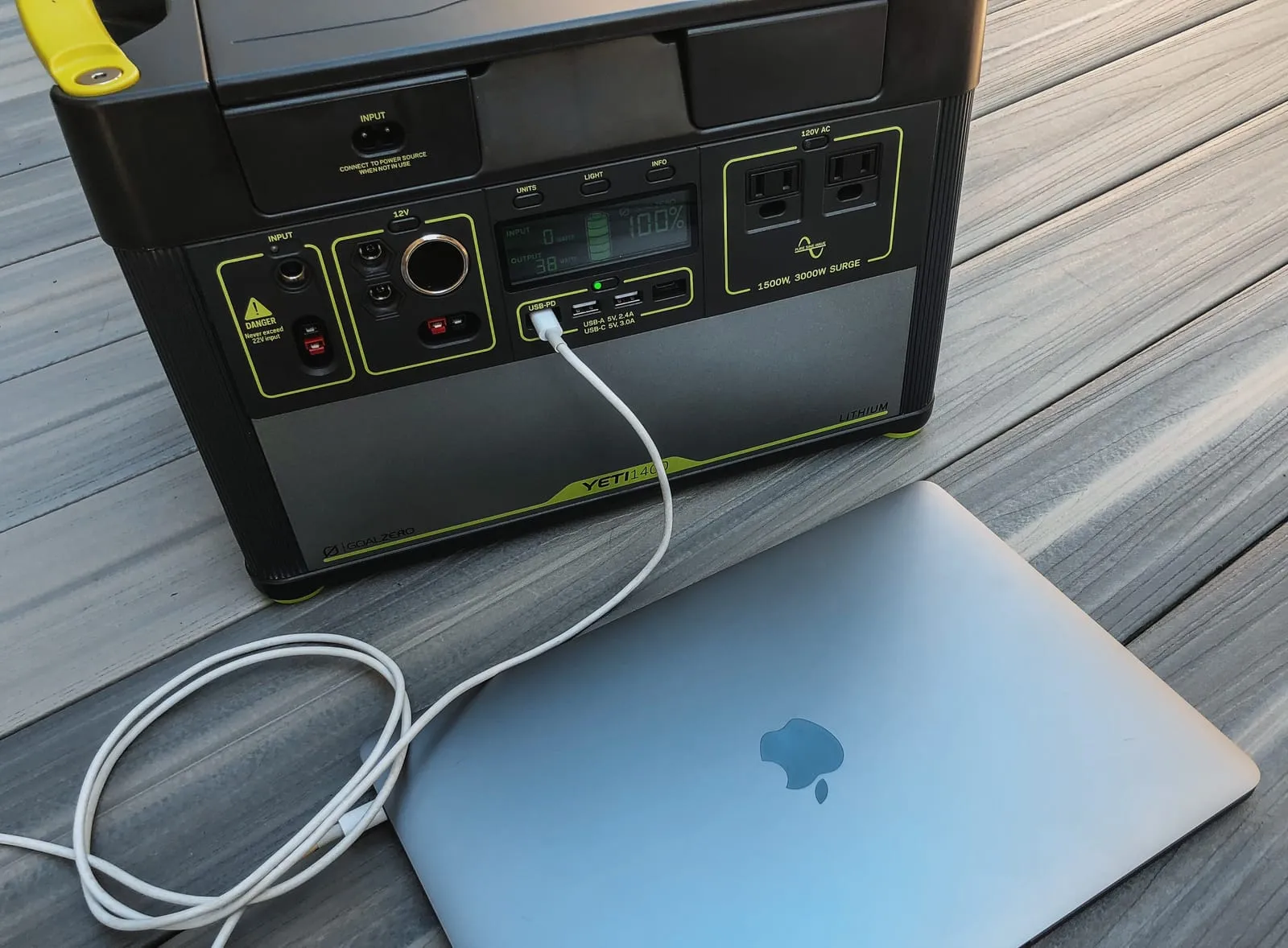

Quick answer: for a short outage, a portable power station is the safe way to keep a phone, a light, a fridge or a medical device running indoors. It’s a big battery with outlets, so it makes no carbon monoxide. A gas generator can make as much carbon monoxide as hundreds of cars, and it must stay outside [1]. Pick a station by watt-hours (how long it lasts) and watts (what it can run at once), and favor models whose makers state a UL 2743 certification [3].
At a glance
- Deaths from generator carbon monoxide
- About 750 in the U.S., 2012 to 2022 [1]
- Where a gas generator can run
- Outdoors only, at least 20 feet from the home [1][2]
- Indoor-safe alternative
- A battery power station: no engine, no exhaust
- Safety standard for power stations
- UL 2743, Portable Power Packs [3]
- Fridge without power
- Keeps food cold for about 4 hours [4]
How we chose
We didn’t test these units. We picked them from the makers’ own spec sheets and the public safety record, using these criteria:
- Safety certification. UL 2743 is UL’s standard for portable power packs: batteries meant to supply power when grid power isn’t available [3]. It covers lithium-ion units up to 20 kWh; bigger systems need UL 9540 [3]. We say exactly what each maker claims, and when a maker’s page doesn’t name UL 2743, we say that too.
- Recall check. We searched CPSC’s recall database for each brand and model on November 2, 2026, and left out anything recalled [5]. Recalls do happen in this category: EcoFlow recalled its Delta Max 2000 (model EFD310) [6], and Goal Zero recalled its YETI 3000X in August 2026 [7]. Neither model is on this list.
- Battery chemistry. Every pick uses LiFePO4 cells, with a maker cycle rating listed below. Some older and lighter models use NMC lithium cells instead; whatever you buy, check the chemistry and the cycle rating on the spec sheet.
- Capacity and output. We list Wh and continuous and surge watts from each maker’s page, plus UPS switchover time where the maker gives one.
The picks
Best for: Phones, lights, a router and a laptop
EcoFlow RIVER 3 Plus
It's the smallest and lightest pick, enough for small electronics through an evening outage. It switches to battery in under 10 ms when plugged into the wall, and you can add an extra battery later [8].
- 286 Wh, LiFePO4, 3,000 cycles to 80% capacity [8]
- 3 AC outlets, 600 W total (1,200 W surge) [8]
- UPS switchover under 10 ms [8]
- 10.4 lb; AC recharge 0 to 100% in 60 minutes [8]
- Expandable to 858 Wh with an extra battery [8]
Safety check: EcoFlow's product page doesn't name a UL 2743 certification for this model. No CPSC recall found for the RIVER 3 Plus (checked 2026-11-02).
Watch out: 286 Wh runs out fast with anything that heats or cools; it isn't meant for a fridge through a long outage.
See it on Amazon → We chose it from specs and safety records; we haven't tested it ourselves.
Best for: A small kit with a stated UL 2743 test
Goal Zero Yeti 500
Goal Zero says the Yeti 500 passes testing to UL 2743 requirements [9]. It holds about 500 Wh in a 16 lb package [9], a step up from the smallest units for lights and electronics.
- 499.2 Wh, LiFePO4, 4,000 cycles to 80% capacity [9]
- AC: 500 W continuous, 1,000 W surge, pure sine wave [9]
- Pass-through charging [9]
- 16.1 lb [9]
Safety check: Goal Zero says it passes testing to UL 2743 requirements. No CPSC recall found for the Yeti 500 (checked 2026-11-02); Goal Zero's 2026 recall covers the YETI 3000X only.
Watch out: The 500 W AC limit rules out microwaves, coffee makers and most other heating appliances.
See it on Amazon → We chose it from specs and safety records; we haven't tested it ourselves.
Best for: Recharging fast between outages
EcoFlow DELTA 3 Plus
It holds about 1 kWh, refills from the wall in under an hour and has six AC outlets [10]. When it's plugged into the wall, its UPS mode switches connected devices to battery in under 10 ms if the power goes out [10].
- 1,024 Wh, LiFePO4, 4,000 cycles to 80%+ capacity [10]
- 6 AC outlets, 1,800 W total (3,600 W surge) [10]
- UPS switchover under 10 ms [10]
- 1,500 W AC charging, 0 to 100% in 56 minutes [10]
- 27.6 lb; expandable to 5 kWh with extra batteries [10]
Safety check: EcoFlow's product page doesn't name a UL 2743 certification for this model. No CPSC recall found for the DELTA 3 Plus (checked 2026-11-02); EcoFlow's recall covers the older Delta Max 2000.
Watch out: At 27.6 lb it's heavy to carry, and the extra batteries that expand it are sold separately.
See it on Amazon → We chose it from specs and safety records; we haven't tested it ourselves.
Best for: A bit more capacity in the 1 kWh class
BLUETTI AC180
It stores 1,152 Wh and puts out 1,800 W across four AC outlets [11], which covers most single household appliances rated under 1,800 W. It also charges and powers devices at the same time [11].
- 1,152 Wh, LiFePO4, 3,500+ cycles to 80% capacity [11]
- 4 AC outlets, 1,800 W total (2,700 W surge) [11]
- AC charging up to 1,440 W [11]
- Pass-through charging [11]
- About 35.3 lb [11]
Safety check: BLUETTI lists 'UL Standard' among its certifications but doesn't name UL 2743 on the product page. No CPSC recall found for BLUETTI or the AC180 (checked 2026-11-02).
Watch out: It's the heaviest of the 1 kWh picks at about 35 lb, and the vague certification wording is worth asking BLUETTI about.
See it on Amazon → We chose it from specs and safety records; we haven't tested it ourselves.
Best for: Longer outages, with a stated UL 2743 certification
Goal Zero Yeti 1500 (6th Gen)
Goal Zero says the 6th-generation Yeti family, including this model, is certified to UL 2743 by a third-party Nationally Recognized Testing Laboratory [12]. At about 1.5 kWh and 2,000 W continuous, it has more stored energy and output than the 1 kWh picks [12].
- 1,505 Wh, LiFePO4, 4,000 cycles to 80% capacity [12]
- AC: 2,000 W continuous, 3,600 W surge, pure sine wave [12]
- Automatic power switching (grid to battery) under 15 ms [12]
- 52.75 lb; 5-year warranty [12]
Safety check: Certified to UL 2743 by a third-party NRTL, per Goal Zero. No CPSC recall found for the Yeti 1500 (checked 2026-11-02); Goal Zero's 2026 recall covers the YETI 3000X only.
Watch out: At 52.75 lb it's a two-hand lift, so keep it where you'll use it.
See it on Amazon → We chose it from specs and safety records; we haven't tested it ourselves.
How to size one
- List what must run at the same time and add up the watts on each label. Pick a station whose continuous AC output is higher than that total. Motors, like a fridge compressor, briefly pull more when they start; that’s what the surge rating is for.
- Estimate runtime. Divide watt-hours by watts. A 1,024 Wh station running a 60 W load lasts about 17 hours on paper. Expect less in practice, because converting battery power to AC uses some of it.
- Plan for medical devices. Ready.gov says to have alternate plans for power-dependent medical devices and refrigerated medicines [4]. Ask your provider about a backup plan [4], and check the device maker’s guidance on running it from a power station.
- Know how you’ll recharge. Wall charging is fastest. During a long outage you’ll need solar panels or a car charger, so check each model’s inputs.
What to avoid
- Unknown brands with no stated certification. If a seller can’t say which safety standard the unit is certified to, skip it.
- Recalled models. Search the brand and model at CPSC’s recall site before you buy, and again if you already own one [5].
- Running fuel-burning heat or cooking indoors as a backup. That’s how outages turn into carbon monoxide poisonings. Use the battery for electric loads and keep anything with exhaust outside [1][2].
- Daisy-chaining power strips to run more than the station’s rated watts. Stay under the continuous rating.
Sources
- U.S. Consumer Product Safety Commission: There's a Chill in the Air: Stay Warm Safely (Jan. 22, 2025)
- Centers for Disease Control and Prevention: About Carbon Monoxide Poisoning
- UL Solutions, The Code Authority: Q&A: Portable Power Packs (UL 2743)
- Ready.gov (FEMA): Power Outages
- U.S. Consumer Product Safety Commission: Recalls
- CPSC: EcoFlow Technology Recalls Delta Max 2000 Power Stations
- CPSC: Goal Zero Recalls YETI 3000X Power Stations (Aug. 2026)
- EcoFlow: RIVER 3 Plus product page and specs
- Goal Zero: Yeti 500 product page and specs
- EcoFlow: DELTA 3 Plus product page and specs
- BLUETTI: AC180 product page and specs
- Goal Zero: Yeti 1500 product page, specs and FAQ
Common questions
Can I use a portable power station indoors?
Yes. A battery power station has no engine and makes no exhaust, so it doesn't produce carbon monoxide. A gas generator is different: CDC and CPSC say never run one inside a home or garage, even with doors and windows open.
What size power station do I need for a power outage?
Add up the watts of what you want to run at the same time and pick a model whose continuous output covers it. Then divide its watt-hours by those watts for a rough runtime. Real runtime is lower because converting to AC uses some power.
What is UL 2743?
It's UL's safety standard for portable power packs: battery units meant to supply power when grid power isn't available. A maker that says its unit is certified to UL 2743 should be able to point to a listing from a recognized testing lab.