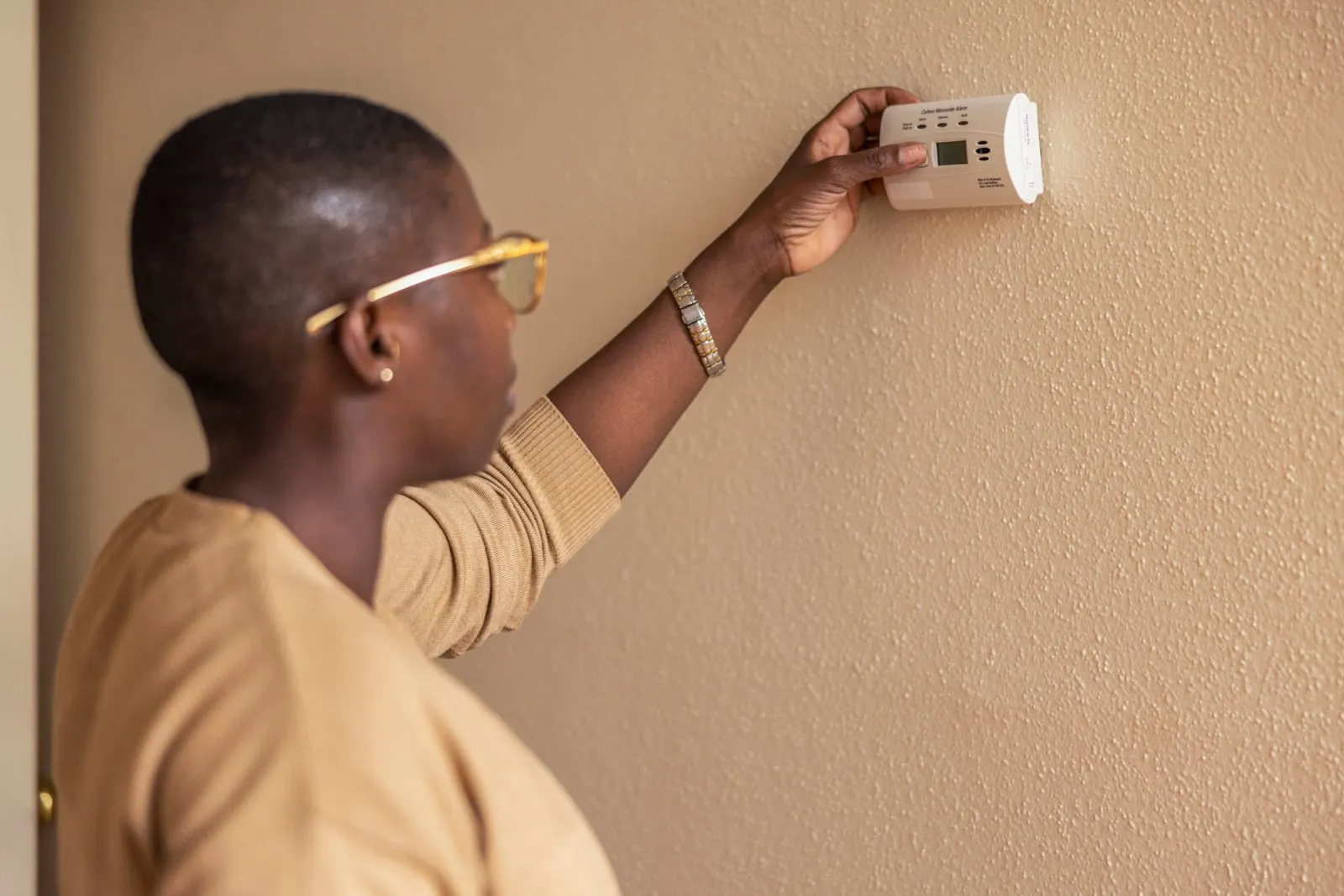

Quick answer: put a carbon monoxide (CO) alarm on every level of your home and outside each sleeping area [2][3], and buy one that’s listed to UL 2034, the safety standard for home CO alarms [4]. A plug-in alarm with a battery backup or a sealed 10-year battery alarm covers most homes. CO has no color or smell [4], and more than 400 Americans die from accidental CO poisoning not linked to fires each year [1].
At a glance
- Deaths each year
- More than 400 from accidental non-fire CO poisoning in the U.S. [1]
- Emergency room visits
- More than 100,000 a year [1]
- Where alarms go
- Every level of the home and outside sleeping areas [2][3]
- Standard to look for
- UL 2034, Single and Multiple Station Carbon Monoxide Alarms [4]
- Upkeep
- Test monthly; replace batteries yearly unless sealed [5]
- Replacement
- Per the maker's instructions, or every 5 years [1]
How we chose
We picked these alarms from their makers’ own spec sheets. We didn’t test them ourselves.
- UL 2034 listing. UL 2034 covers CO alarms for ordinary indoor spaces, and it requires an end-of-life tone that sounds different from the alarm [4]. Every pick is UL listed according to its maker; we note where the maker names UL 2034 and where it just says “UL listed.”
- Power that survives an outage. The CPSC says to use battery-operated alarms or alarms with battery backup [2]. Outages are when people run generators and fuel-burning heaters, so a plug-in alarm without a backup isn’t on this list.
- An electrochemical sensor and an 85-decibel alarm, per each maker’s spec sheet.
- No recall. We searched the CPSC’s recall list for each brand and model on November 2, 2026, and left out anything recalled [6].
Our picks
Best for: An outlet near the bedrooms, with no backup battery to change
Kidde Worry-Free Living Area Plug-in CO Alarm (KN-COP-DP-10YL)
It plugs into the wall and has a sealed lithium backup battery built in for the alarm's 10-year life, so there are no backup batteries to buy. The display shows the CO level in parts per million, and a peak-level button shows the highest reading since the last reset [7].
- 120 V plug-in with sealed lithium battery backup [7]
- Digital CO display in PPM that dims in low light; peak level memory [7]
- Electrochemical sensor; 85 dB at 10 feet [7]
- 10-year life with end-of-life warning; 10-year limited warranty [7]
- Rotating plug fits vertical or horizontal outlets [7]
Safety check: Listed by UL to UL 2034 per Kidde; no CPSC recall found for this model (checked 2026-11-02).
Watch out: The display turns off when the power is out, and it can't be interconnected with other alarms [7].
See it on Amazon → We chose it from specs and safety records; we haven't tested it ourselves.
Best for: An outlet that's too low or in the wrong spot
First Alert Plug-In CO Alarm with Battery Backup and Digital Display (CO3-P01D)
It plugs into any standard outlet and comes with an optional 6-foot cord, so you can set it where it's easy to see. Two AA batteries keep it working in an outage, and it stores the highest CO level it has recorded [8].
- Plug-in with optional 6-foot extendable cord [8]
- 2 AA alkaline backup batteries (replaceable) [8]
- Backlit digital display; stores the highest CO level recorded [8]
- Electrochemical sensor; 85 dB at 10 feet [8]
- Replace at least every 7 years; 7-year limited warranty [8]
Safety check: Conforms to UL 2034 per First Alert; no CPSC recall found for this model (checked 2026-11-02).
Watch out: You'll need to replace the AA batteries, and its 7-year life is shorter than the 10-year Kidde picks. First Alert's own store showed it backordered when we checked.
See it on Amazon → We chose it from specs and safety records; we haven't tested it ourselves.
Best for: Rooms without a handy outlet
Kidde Worry-Free CO Alarm with Digital Display (C3010D)
It runs on a sealed lithium battery for its full 10-year life, so it can go on a wall or shelf anywhere. It shows CO levels from 30 to 999 PPM and keeps a peak reading, which helps you see a low-level problem the alarm isn't designed to sound for [4][9].
- Sealed lithium battery; no battery changes over its 10-year life [9]
- Digital display, 30 to 999 PPM; peak level memory [9]
- Electrochemical sensor; 85 dB at 10 feet [9]
- Turns on when attached to its mounting bracket [9]
- 10-year limited warranty [9]
Safety check: UL listed per Kidde (the page doesn't name the standard; UL 2034 is the UL standard for home CO alarms [4]); no CPSC recall found for this model (checked 2026-11-02).
Watch out: It has no wall power at all. When the battery or sensor reaches end of life, you replace the whole alarm.
See it on Amazon → We chose it from specs and safety records; we haven't tested it ourselves.
Best for: Homes with natural gas or propane appliances
Kidde Nighthawk Plug-in CO and Explosive Gas Alarm (KN-COEG-3)
One plug-in unit warns of carbon monoxide and of natural gas (methane) or propane. Its display shows the CO level, or the word GAS when it senses explosive gas, and a 9-volt battery keeps it working in an outage [10].
- Detects CO plus natural gas or propane [10]
- 120 V plug-in with 9 V battery backup [10]
- Digital CO display; peak level memory [10]
- 85 dB at 10 feet; plugs in directly, on a 6-foot cord, or sits on a table [10]
- 7-year life; 5-year limited warranty [10]
Safety check: Listed to UL 2034 (CO) and UL 1484 (gas) per Kidde; no CPSC recall found for this model (checked 2026-11-02).
Watch out: Its 7-year life and 5-year warranty are shorter than the other Kidde picks, and it can't be interconnected [10]. Kidde also sells a newer gas and CO plug-in (COPDLG), so this one may be harder to find.
See it on Amazon → We chose it from specs and safety records; we haven't tested it ourselves.
Best for: Replacing an old battery smoke alarm with one that also senses CO
Kidde Worry-Free Smoke and CO Combination Alarm (P3010CU)
It combines a photoelectric smoke sensor and an electrochemical CO sensor and runs on a sealed 10-year lithium battery. A voice tells you which danger it found: 'Fire!' or 'Warning, carbon monoxide' [11].
- Photoelectric smoke sensor and electrochemical CO sensor [11]
- Sealed lithium battery for its 10-year life [11]
- Voice alarm plus 85 dB horn at 10 feet [11]
- Hush button for nuisance alarms; end-of-life chirp [11]
- 10-year limited warranty [11]
Safety check: Listed to UL 217 (smoke) and UL 2034 (CO) per Kidde; no CPSC recall found for this model (checked 2026-11-02). Kidde has recalled other combination alarms, including some TruSense models in 2021 [12].
Watch out: It has no CO display and no interconnect [11]. Kidde's page points to a newer model (30CUD10-V) as an upgrade.
See it on Amazon → We chose it from specs and safety records; we haven't tested it ourselves.
What matters when you buy
- The UL 2034 listing. Look for it on the box and the back of the alarm. It’s the standard for single- and multiple-station home CO alarms [4].
- A display with peak memory, if you can. UL 2034 alarms aren’t meant to sound for long-term, low-level CO or brief spikes [4]. A display lets you see lower readings, and a stored peak helps responders.
- Battery backup or a sealed battery. A plug-in alarm with no backup goes quiet in an outage [2].
- Interconnection, if you can get it. The CPSC says interconnected alarms are best, because when one sounds, they all sound [2]. None of our picks interconnect. If you want that, look at hardwired or wireless-interconnect models, and check that each one is listed to UL 2034.
- Enough alarms. The U.S. Fire Administration says to put one in a central spot outside each separate sleeping area, and on every level [3].
What to avoid
- No-name combo alarms sold only online. The CPSC has announced recalls or warnings for several combination smoke and CO detectors sold on Amazon by little-known sellers, including Treatlife in 2026 and CHZHVAN in 2024 [13][14]. Stick to established brands and check the model at cpsc.gov/Recalls [6].
- Alarms past their end-of-life date. Check the date on the back and the maker’s replacement schedule [1].
- Treating a CO alarm as a smoke alarm. A CO-only alarm doesn’t sense smoke. You need working smoke alarms too, or a combination alarm.
Sources
- Centers for Disease Control and Prevention: About Carbon Monoxide Poisoning
- U.S. Consumer Product Safety Commission: Carbon Monoxide Information Center
- U.S. Fire Administration (FEMA): Carbon Monoxide Poisoning Prevention
- UL Standards & Engagement: Safety Standards for CO-Detecting Devices (2023)
- U.S. Consumer Product Safety Commission: There's a Chill in the Air: Stay Warm Safely (January 22, 2025)
- U.S. Consumer Product Safety Commission: Recalls
- Kidde: Worry-Free Living Area Plug-in CO Alarm KN-COP-DP-10YL
- First Alert: Plug-In Carbon Monoxide Alarm with Battery Backup and Digital Display (CO3-P01D)
- Kidde: Sealed Lithium Battery Power CO Alarm with Digital Display C3010D
- Kidde: AC Plug-in CO and Explosive Gas Alarm with Digital Display KN-COEG-3
- Kidde: Combination Smoke and CO Alarm with Sealed Lithium Battery P3010CU
- CPSC: Kidde Recalls TruSense Smoke and Combination Smoke/CO Alarms (2021)
- CPSC: Treatlife Combination Smoke and CO Detectors Recalled (2026)
- CPSC: CHZHVAN Combination Smoke and CO Detectors Recalled (2024)
- NFPA: Heating Safety tip sheet
Common questions
Where should I put carbon monoxide alarms?
On every level of your home and outside sleeping areas, according to the CPSC. The U.S. Fire Administration says to use a central spot outside each separate sleeping area. Follow the alarm's manual for exact height and distance from appliances.
How often should I replace a carbon monoxide alarm?
Follow the maker's instructions. The CDC says to replace it per the manufacturer or every 5 years. Many current alarms are rated for 7 or 10 years and sound a distinct end-of-life signal when it's time.
What should I do if my carbon monoxide alarm goes off?
The CPSC says that if you suspect CO poisoning, get outside to fresh air right away, then call 911.