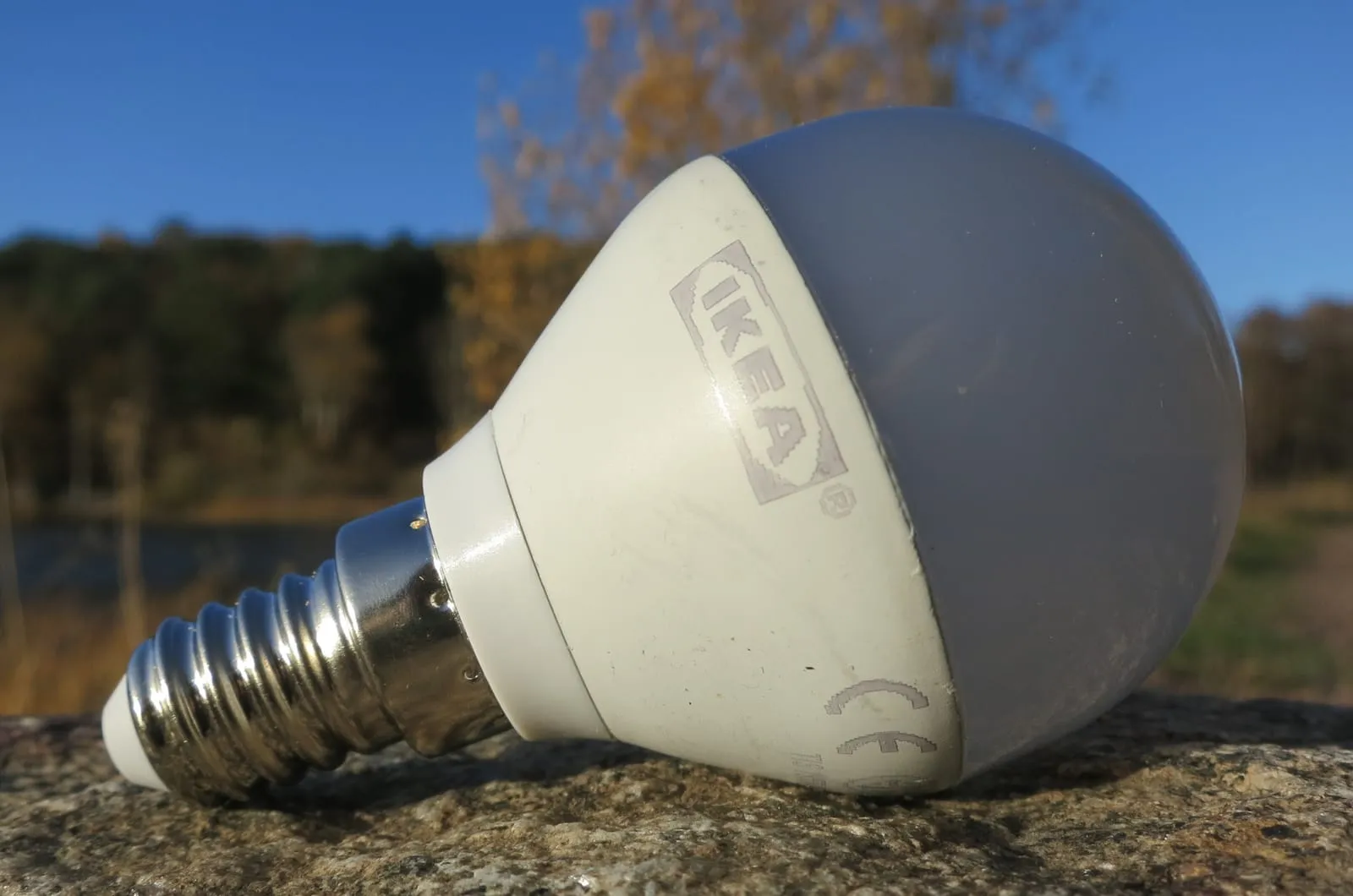

Quick answer: buy LED bulbs by lumens, not watts. About 800 lumens replaces a 60-watt incandescent [2], and about 1,100 lumens replaces a 75-watt [1]. LEDs use up to 90% less energy and last up to 25 times longer than incandescent bulbs, according to the Department of Energy [1]. Then match the bulb to the fixture: a closed ceiling dome needs an enclosed-rated bulb, an outdoor flood needs a wet-location rating, and a dimmer needs a dimmable bulb.
At a glance
- Lighting's share of home electricity
- About 15% [1]
- LED vs. incandescent
- Up to 90% less energy, up to 25 times the life [1]
- 60-watt replacement
- About 800 lumens [2]
- 75-watt replacement
- About 1,100 lumens [1]
- ENERGY STAR for bulbs
- Specification sunset December 31, 2024 [3]
- What to read instead
- The FTC's Lighting Facts label [1][2]
How we picked
We picked these bulbs from data, not from testing them ourselves.
- Certified numbers. ENERGY STAR stopped certifying light bulbs on December 31, 2024 [3]. Before it did, makers reported each model’s lumens, watts, rated life, color rendering and fixture ratings, and EPA published a final list of bulbs that qualified [4]. Every figure in the cards below comes from that list. Makers can change a product after certification, so check the box before you buy.
- Color quality. All four picks list a CRI of 91 or higher [4]. We also note R9, the score for deep reds, where it’s high.
- The right rating for the fixture. We note whether each bulb is rated for enclosed fixtures, damp or wet locations, and dimmers [4].
- Recall history. Any bulb with a CPSC recall was out; we ran each brand and model through the recall database on November 6, 2026 [5].
- Sold as a single bulb. We only picked bulbs we could match to a one-bulb Amazon listing, so the link goes to the exact model. That’s why all four picks are Feit Electric; other brands’ bulbs with the same certified numbers are just as good.
The bulbs
Best for: Everyday lamps and ceiling fixtures, including closed domes
Feit Electric 60W-Equivalent A19 LED, 2700K (OM60DM/927CA)
A plain 800-lumen soft white bulb with a CRI in the low 90s and a 25,000-hour rated life. It's dimmable and rated for enclosed fixtures and damp locations [4].
- 800 lumens on 8.8 watts; 2700K [4]
- CRI 91 to 93, depending on the production version EPA listed [4]
- Dimmable to 5% (one version to 1%) [4]
- Rated for enclosed fixtures and damp locations [4]
- 25,000-hour rated life; 3- or 5-year warranty by version [4]
Safety check: On EPA's final ENERGY STAR lamp list (several versions qualified 2020 to 2023) [4]; no CPSC recall found for Feit Electric or this model (checked 2026-11-06).
Watch out: Feit certified several production versions under this model number, with slightly different color scores and warranties [4]. It's damp-rated, not wet-rated, so keep it out of uncovered outdoor fixtures.
See it on Amazon → We chose it from specs and safety records; we haven't tested it ourselves.
Best for: Recessed ceiling cans
Feit Electric 65W-Equivalent BR30 LED Flood, 2700K (BR30DM/927CA)
It's a BR30 reflector bulb rated for recessed and enclosed fixtures. It dims to 5% and has a 25,000-hour rated life [4].
- 650 lumens on 7.2 watts; 2700K [4]
- CRI 91 [4]
- Dimmable to 5% [4]
- Rated for enclosed and recessed fixtures and damp locations [4]
- 25,000-hour rated life; 5-year warranty [4]
Safety check: On EPA's final ENERGY STAR lamp list (qualified 2018) [4]; no CPSC recall found for Feit Electric or this model (checked 2026-11-06).
Watch out: It's an older certification, and 650 lumens is modest. For a tall ceiling, look for a brighter BR30 and check its Lighting Facts label.
See it on Amazon → We chose it from specs and safety records; we haven't tested it ourselves.
Best for: Outdoor floodlights and motion-sensor fixtures
Feit Electric 120W-Equivalent PAR38 LED Flood, 3000K (PAR38DM/1400/930CA)
It's rated for wet locations, so it can sit in an exposed outdoor flood fixture, and it's listed for use with photocells and motion sensors. It puts out 1,400 lumens on 15.5 watts [4].
- 1,400 lumens on 15.5 watts; 3000K [4]
- CRI 92 [4]
- Rated for wet and damp locations, enclosed and recessed fixtures [4]
- Works with timers, photocells and motion sensors [4]
- 25,000-hour rated life; 5-year warranty [4]
Safety check: On EPA's final ENERGY STAR lamp list (qualified 2019) [4]; no CPSC recall found for Feit Electric or this model (checked 2026-11-06).
Watch out: PAR38 bulbs are large. Measure your fixture, and check that the flood fixture itself is rated for wet locations.
See it on Amazon → We chose it from specs and safety records; we haven't tested it ourselves.
Best for: Changing color or white tone from a phone
Feit Electric Smart Wi-Fi A19, Color and Tunable White (OM60/RGBW/CA/AG)
A single Wi-Fi bulb that changes color and shifts white light from warm to cool, without a hub. EPA's listing records it as rated for enclosed fixtures, which many smart bulbs aren't [4].
- 800 lumens on 9 watts; rated at 2700K [4]
- CRI 91 to 93, depending on the version EPA listed [4]
- Wi-Fi; standby draw 0.08 to 0.3 watt by version [4]
- Rated for enclosed fixtures; damp location rated [4]
- 25,000-hour rated life; 3-year warranty [4]
Safety check: On EPA's final ENERGY STAR lamp list as a connected bulb (versions qualified 2018 to 2023) [4]; no CPSC recall found for Feit Electric or this model (checked 2026-11-06).
Watch out: Some versions dim only to 10% or 20% [4], so it won't go as low as the plain A19. It needs a 2.4 GHz Wi-Fi network and Feit's app.
See it on Amazon → We chose it from specs and safety records; we haven't tested it ourselves.
Reading the Lighting Facts label
The FTC requires a Lighting Facts label on bulb packages [1]. It lists brightness in lumens, estimated yearly energy cost, expected life, light appearance, wattage and whether the bulb contains mercury [2].
- Brightness first. Lumens measure light; watts measure power [1].
- Light appearance. The label shows where the bulb falls from warm (more yellow) to cool (more blue) [2]. On the Kelvin scale, lower numbers look warmer [1].
- Don’t count on the ENERGY STAR logo. The FTC says the label might include it if the bulb meets ENERGY STAR’s standards [2], but EPA’s bulb specification ended in 2024 [3].
- Dimmers. Most LEDs are dimmable [1], but not all; it’s printed on the box and noted in each card above.
Mistakes to skip
- A non-rated bulb in a closed fixture. In a fixture that closes the bulb in, such as a ceiling dome, use a bulb rated for enclosed fixtures; ENERGY STAR recorded that rating for every bulb it listed [4].
- Buying by “watt equivalent” alone. Equivalents are a shortcut; compare the lumens on the label [1].
- Throwing out an old CFL with the trash. CFLs contain mercury; the FTC points to EPA’s guidance on cleanup and recycling [2].
Sources
- U.S. Department of Energy: Consumer Guide to Energy-Efficient Lighting (Energy Saver)
- Federal Trade Commission: Shopping for Light Bulbs
- ENERGY STAR: Light Fixtures and Lamps, Partner Resources (lighting sunset, December 31, 2024)
- ENERGY STAR: Previously Certified Lamps, Version 2.1 (final list before the December 31, 2024 sunset, Excel)
- U.S. Consumer Product Safety Commission: Recalls
Common questions
How many lumens replace a 60-watt bulb?
About 800 lumens. The FTC says a traditional 60-watt incandescent bulb produces about 800 lumens, and the Department of Energy says to look for about 1,100 lumens to replace a 75-watt bulb.
Are LED bulbs still ENERGY STAR certified?
Not new ones. EPA sunset its ENERGY STAR specification for lamps (light bulbs) on December 31, 2024, and posted a final list of bulbs that qualified before then. Use the Lighting Facts label on the box to compare brightness, watts and color instead.
Can I put an LED bulb in an enclosed light fixture?
Only if the bulb is rated for enclosed fixtures. The rating is printed on the package and was recorded on ENERGY STAR's lamp listings. Every pick on this page carries that rating.
What color temperature should I buy?
Lower Kelvin numbers look warmer and more yellow, like an old incandescent bulb; higher numbers look cooler and bluer. 2700K is the warm white most people know from incandescent lighting. The Lighting Facts label shows where a bulb falls on that scale.