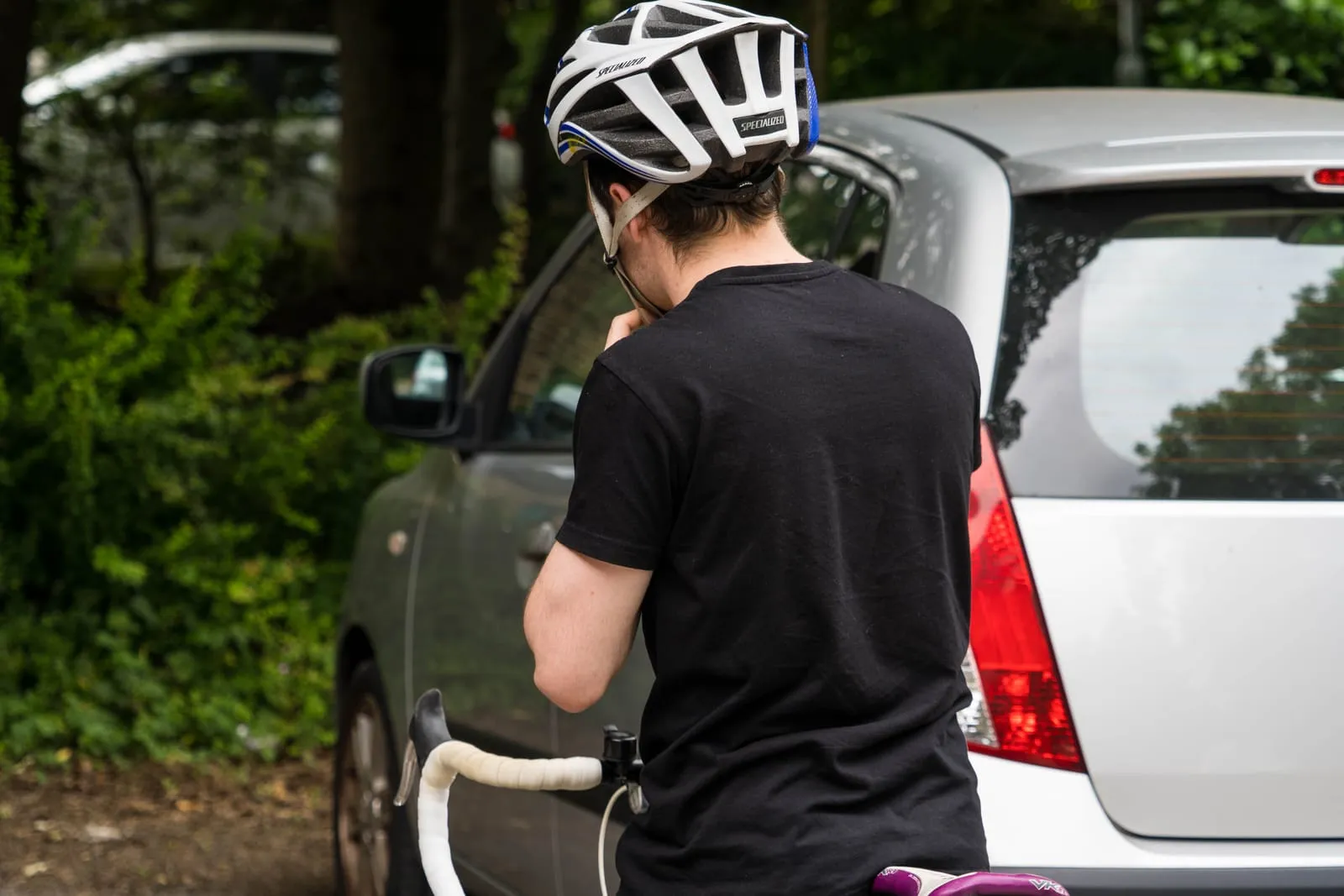

Quick answer: any bike helmet sold in the U.S. has to meet the federal CPSC standard, so start by finding the compliance label inside the shell [1][2]. Then use the free crash-test scores from Virginia Tech’s helmet lab to pick a better performer: the lab recommends helmets rated 4 or 5 stars [3]. A helmet only protects you if it fits, and it’s done after one crash [2].
At a glance
- Federal standard
- CPSC 16 CFR Part 1203, required for bike helmets made after 1999 [2]
- What the label must say
- That the helmet complies, plus the maker and the month and year made [1]
- Impact test limit
- No sample may exceed 300 g peak acceleration [1]
- After a crash
- Replace it, even with no visible damage [2]
- No crash?
- Follow the maker; otherwise 5 to 10 years may be prudent, per the CPSC [2]
- Independent ratings
- Virginia Tech and IIHS rate helmets 1 to 5 stars; the lab suggests 4 or 5 [3]
How we chose
These picks come from makers’ spec sheets, Virginia Tech’s published lab ratings and the CPSC’s recall records. We didn’t test any of them ourselves.
- A stated CPSC compliance. The CPSC standard sets impact, chin-strap strength, stability and side-vision tests [1]. Every adult pick’s maker states CPSC compliance on its product page, size chart or Amazon listing. Where a maker doesn’t spell it out, we say so.
- Independent crash ratings where they exist. Virginia Tech’s lab uses its STAR method, which measures linear and rotational head motion in impacts meant to match real bike crashes. A lower score is better [3]. It’s the lab’s testing, not ours.
- Different riders. One pick each for everyday riding, commuting on an e-bike, mountain trails and toddlers, each from a different brand.
- No recall. We searched the CPSC recall database for each brand and model on November 6, 2026, and left out anything recalled [8]. We also passed on a budget brand whose children’s helmets were recalled in 2025 for failing the federal standard, even though its adult model wasn’t part of that recall.
Plenty of other helmets carry the same marks. Use the checks below on any helmet you’re considering.
Our picks
Best for: Everyday riding, all year round
Bern Macon 2.0 MIPS
A skate-style hard-shell helmet for around-town riding that Bern certifies to the U.S. bike standard and to EN1077B, a European snow-sports standard, so it also works with Bern's winter knit liner. Virginia Tech rates it 4 stars [3][4].
- Complies with the U.S. CPSC standard for bicycle helmets, age 5 and older; EN1077B and EN1078 [4]
- MIPS; Compass Fit dial system [4]
- About 400 g; 12 vents [4]
- Virginia Tech rating: 4 stars, score 12.197 [3]
Safety check: CPSC compliance stated by Bern; no CPSC recall found for Bern or the Macon 2.0 (checked 2026-11-06).
Watch out: Its Virginia Tech score is the weakest of the rated picks here, and a hard shell runs warmer than a vented road helmet [3]. Bern sells a Macon 2.0 Hard Hat for skating that isn't certified for biking, so make sure the listing says MIPS Bike Helmet [4].
See it on Amazon → We chose it from specs and safety records; we haven't tested it ourselves.
Best for: City commuting and e-bikes
ABUS Pedelec 2.0 MIPS
An urban helmet built for e-bike riders, with coverage down over the temples. Virginia Tech lists it as certified to CPSC and to NTA 8776, a Dutch standard for e-bike helmets, and rates it 4 stars [3][5].
- CPSC certified, per ABUS's Amazon listing [5]
- Certifications listed by Virginia Tech: CPSC, EN 1078, NTA 8776, ASTM [3]
- MIPS; dial fit system; size M fits 52 to 57 cm [5]
- Virginia Tech rating: 4 stars, score 11.143 [3]
Safety check: No CPSC recall found for the Pedelec 2.0 (checked 2026-11-06). ABUS's only bicycle helmet recall in the CPSC database is from 2021 and involved a youth model, the MountZ [9].
Watch out: We couldn't open ABUS's U.S. spec page, so the details here come from ABUS's Amazon listing and Virginia Tech's database. Sizes and colors are sold as separate listings; pick the size for your head before you order [5].
See it on Amazon → We chose it from specs and safety records; we haven't tested it ourselves.
Best for: Mountain biking and e-mountain bikes
Fox Racing Speedframe Pro (Mips Air Node, BOA)
An open-face trail helmet that earned Virginia Tech's top rating, with the best score of any pick here. It has a one-hand adjustable visor that works with goggles or sunglasses [3][6].
- Virginia Tech rating: 5 stars, score 8.096 [3]
- Mips Air Node; dual-density Varizorb EPS [6]
- BOA dial fit and four-position back cradle; FIDLOCK magnetic buckle [6]
- Sizes S, M and L (51 to 63 cm); size L weighs about 390 g in its CPSC-certified version [6]
Safety check: Fox's size chart lists a CPSC-certified version, and Virginia Tech lists CPSC certification [3][6]; no CPSC recall found for Fox Racing or the Speedframe (checked 2026-11-06).
Watch out: Fox sells an older Speedframe Pro with a different fit system; this pick is the newer version with BOA and Mips Air Node. Fox states CPSC certification only in its size chart, so confirm the label inside [1][6].
See it on Amazon → We chose it from specs and safety records; we haven't tested it ourselves.
Best for: Toddlers riding in a trailer or bike seat
Giro Scamp Mips II
Giro's smallest helmet. Giro says the XS is designed for riders age 1 and older and the S for age 5 and older, so even a toddler gets a helmet sized for them. The dial fit lets it grow with a child for a few years [7].
- XS (45 to 49 cm) designed for age 1 and older; S (49 to 53 cm) for age 5 and older [7]
- Mips Evolve Core; Roc Loc Junior dial fit [7]
- In-mold EPS foam with polycarbonate shell; 13 vents [7]
Safety check: No CPSC recall found for the Scamp Mips II (checked 2026-11-06). Giro's U.S. page lists only the European CE EN 1078 mark under certifications, so confirm the CPSC label inside the helmet when it arrives [1][7].
Watch out: Giro's own store showed it sold out when we checked [7]. Kids outgrow the XS quickly; recheck the fit each season.
See it on Amazon → We chose it from specs and safety records; we haven't tested it ourselves.
| Helmet | Category | Stars | Score (lower is better) | Certifications listed |
|---|---|---|---|---|
| Fox Racing Speedframe Pro | Mountain | 5 | 8.096 | CPSC |
| ABUS Pedelec 2.0 MIPS | Urban | 4 | 11.143 | CPSC, EN 1078, NTA 8776, ASTM |
| Bern Macon 2.0 MIPS | Multi-sport | 4 | 12.197 | CPSC |
How to check any helmet before you buy
- Find the label, not just the logo. The CPSC says not to rely on a helmet’s name, looks or packaging claims. A compliant helmet has a label or marking inside, on the shell or on the strap [2].
- Look the model up. The CPSC’s recall list for 2026 includes at least seven recalls of bicycle helmets sold on Amazon by little-known sellers for failing the federal standard, including 5Color and Tongyang Cycling helmets in September 2026 [8][10][11]. Search the exact name at cpsc.gov/Recalls before you buy [8].
- Skip add-ons the helmet didn’t come with. The CPSC warns that stickers, covers and attachments can hurt a helmet’s performance, and that novelty helmets with horns or spikes can catch on the ground in a fall [2].
- Know what Mips is and isn’t. Mips is a low-friction layer designed to reduce rotational motion in certain impacts [6]. Giro adds a warning that Mips layers and other helmet parts may cause cuts in some crashes [7].
Getting the fit right
The CPSC says a helmet should be comfortable and snug, sit level on your head and not be tipped back or pulled too low over your forehead [2]. Tighten the dial, then the chin strap; the federal standard requires straps strong enough to keep the helmet on your head in a fall, but they can only do that when they’re buckled and snug [2]. Use the maker’s size chart and measure your head first [5][6][7].
Sources
- U.S. Consumer Product Safety Commission: Bicycle Helmets business guidance (16 CFR Part 1203)
- U.S. Consumer Product Safety Commission: Which Helmet for Which Activity? (brochure, January 2026)
- Virginia Tech Helmet Lab: Bicycle Helmet Ratings
- Bern: Macon 2.0 MIPS Bike Helmet
- ABUS: Pedelec 2.0 MIPS Urban Helmet, CPSC Certified (ABUS's Amazon listing)
- Fox Racing: Speedframe Pro Backfade Helmet (features and size guide)
- Giro: Scamp Mips II Helmet
- U.S. Consumer Product Safety Commission: Recalls
- CPSC: ABUS Recalls Youth Helmets Due to Risk of Head Injury (2021, MountZ)
- CPSC: 5Color Recalls Children's Bicycle Helmet and Pads Sets (2026)
- CPSC: Tongyang Cycling Recalls Basecamp Bicycle Helmets (2026)
Common questions
What safety standard should a bike helmet meet in the U.S.?
The CPSC bicycle helmet standard, 16 CFR Part 1203. Bike helmets made after 1999 must meet it, and each one must carry a label inside stating that it complies, along with the maker's name and the month and year it was made.
How often should I replace my bike helmet?
Right away after any crash where your head hit something, even if the helmet looks fine, because the foam crushes once and won't protect you again. Otherwise, follow the maker's instructions. The CPSC says that without them, replacing a helmet within 5 to 10 years of purchase may be prudent.
Do I need a special helmet for an e-bike?
Any bike helmet sold in the U.S., including one you wear on an e-bike, has to meet the CPSC bicycle helmet standard. Some makers also certify helmets to NTA 8776, a Dutch e-bike helmet standard, and list it on the spec sheet.
What do Virginia Tech's helmet ratings mean?
Virginia Tech's helmet lab, working with the Insurance Institute for Highway Safety, crash-tests bike helmets and gives each one 1 to 5 stars. More stars are associated with lower concussion risk in the impacts it tests, and the lab recommends a helmet rated 4 or 5 stars.