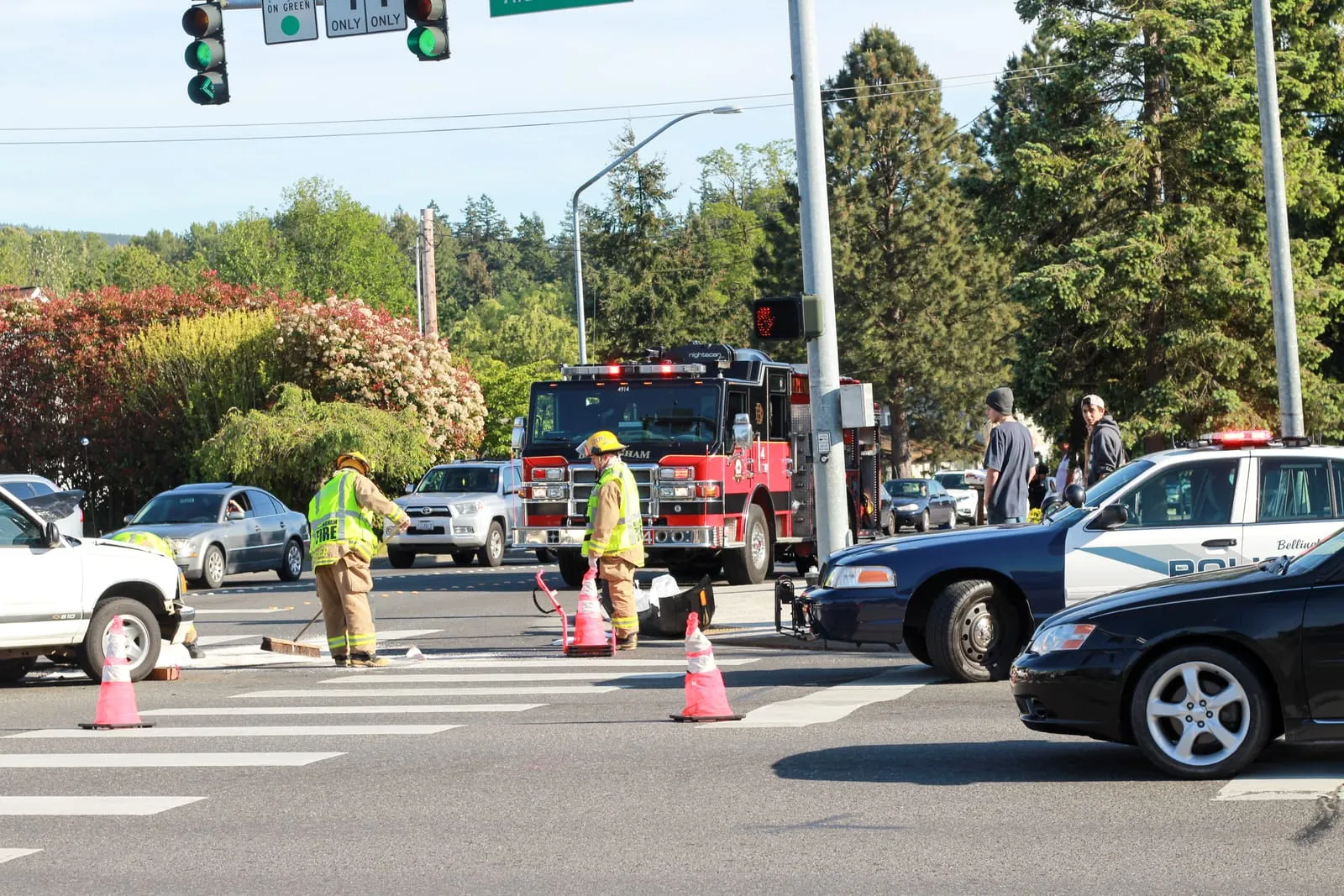

After a crash, the insurance company assigns a claims adjuster to assess the damage and decide how much it pays [1]. The adjuster works for the insurer, not for you. How you deal with one depends mostly on whose insurer it is: your own company owes you what your policy promises, while the other driver’s company has no contract with you at all [2].
At a glance
- Adjuster's job
- Assess the damage and determine the payment [1]
- Your own insurer
- Your policy requires you to cooperate, including statements [4]
- Other driver's insurer
- No contract with you, so fewer options [2]
- Medical authorizations
- Must say what, who, why and when it expires; revocable in writing [5]
- Repair shop
- You can generally choose your own [3][4]
- Disagree?
- Ask for a written explanation, then your state insurance department [1]
First-party and third-party adjusters
There are two kinds of claim after most accidents, and the adjuster on each one has a different relationship with you.
- First-party claim. You claim on your own policy, for example under collision, medical payments or uninsured motorist coverage. Your policy requires you to cooperate with the company’s investigation [4]. If you refuse to cooperate with an examination under oath the policy requires, the claim may be denied [11].
- Third-party claim. You claim against the other driver’s insurance because that driver caused the crash. That company should pay for your repairs, medical bills and a rental car, but there’s no guarantee it will. It may say its driver wasn’t at fault, that you share the blame, or that its driver doesn’t have enough coverage [2]. Because you don’t have a contract with it, you don’t have the same options you’d have with your own insurer [2].
If the other driver’s insurer won’t pay, you can usually claim under your own coverage instead. Collision pays your repairs (minus your deductible), and your insurer will then try to recover what it paid from the other driver’s insurer. If it succeeds, you may get your deductible back [2].
Recorded statements
Adjusters often ask for a statement early. Your own insurer may take a written or recorded statement as part of the claim [4], and cooperating is part of your policy.
The other driver’s adjuster is in a different position: that company’s job is to pay its own policyholder’s claims, and you have no contract with it [2]. If you were injured, many people speak with an attorney before giving that company a recorded statement. Whoever you talk to, stick to facts you know, and don’t guess about speed, distance or how badly you’re hurt.
At the scene, don’t sign statements about who was at fault or promise to pay for the other party’s damage [4].
Medical authorizations
In an injury claim, the adjuster may send a form asking you to authorize your doctors to release your records. Under the federal HIPAA privacy rule, a valid authorization has to include [5]:
- a specific description of the information to be released,
- who may release it and who may receive it,
- the purpose,
- an expiration date or event, and
- your signature and the date.
You can revoke an authorization at any time in writing, except to the extent a provider has already acted on it, or where an insurer has a legal right to contest a claim [5]. Before you sign, check whether the form covers only the injuries and treatment from the accident, or your whole medical history. You can ask for it to be narrowed.
What to document
The more you can show, the less the claim depends on anyone’s memory. State insurance regulators recommend that you:
- Write down the location, time, weather and what happened, and photograph the cars, license plates, damage, street signs and road layout [3].
- Photograph the other driver’s insurance card and driver’s license, or write down their name, phone number, insurer and policy number [3].
- Get names and phone numbers of witnesses [3].
- Get a copy of the police report if police responded [2][3].
- Report the accident to your own insurer and get the name and phone number of your adjuster [3].
- Keep medical records and bills if you see a doctor [3].
- Keep notes of the dates of every conversation with your agent or adjuster [1], and follow up phone calls with an email or letter.
For repairs, you can generally use any body shop, not only one on the insurer’s list [3]. In California, for example, an insurer can’t require that your car be repaired at a specific shop [4].
How fast the insurer has to respond
Each state sets its own claim-handling deadlines. In California, for example, an insurer has 15 calendar days to acknowledge your claim and start investigating [7]. Texas also gives insurers 15 days to acknowledge a claim [6]. The table compares the main steps:
| Step | California | Texas |
|---|---|---|
| Acknowledge the claim | 15 calendar days after notice [7] | 15 days after notice [6] |
| Accept or deny | 40 calendar days after proof of claim [8] | 15 business days after it has everything it needs [6] |
| If it needs more time | Written notice every 30 days [8] | Up to 45 days to decide [6] |
| Pay once accepted | 30 calendar days [8] | — |
In California, a written denial has to list every reason for it, cite the policy provision it relies on, and tell you that you can have the matter reviewed by the California Department of Insurance [8].
Settlement offers
In an injury claim caused by another driver, that driver’s insurer will offer a settlement and ask you to sign a release promising you won’t file more claims for the accident [6]. Once you sign, that’s usually the end of it, even if you later need more treatment. Before you sign, talk to your doctor about any future medical care you might need [6].
If you disagree about the value of the damage to your car, check your own policy for an appraisal clause [1]. Some states also offer mediation for disputed auto claims; Florida, for example, runs one through its Department of Financial Services [11].
If the insurer won’t treat you fairly
The NAIC, the national association of state insurance regulators, publishes a model law on unfair claims practices that states can adopt. It lists practices an insurer can’t commit flagrantly or as a general business practice, including [9]:
- misrepresenting the facts or the policy,
- failing to acknowledge communications about a claim with reasonable promptness,
- refusing to pay without a reasonable investigation,
- not trying in good faith to settle promptly and fairly once liability is reasonably clear, and
- failing to promptly explain a denial or a compromise offer.
If you can’t resolve a dispute with the adjuster or a supervisor, ask your state insurance department’s consumer services staff for help [1]. The NAIC lists every state’s department and how to file a complaint [10]. For details on that process, see Insurance Claim Denied? How to Appeal, Complain and Push Back.
When people get a lawyer
If the other driver’s insurer still won’t pay for your damage or medical bills, the Texas Department of Insurance says your next option is to get legal help [2]. People also commonly talk to an attorney when they were seriously hurt, when fault is disputed, when the at-fault driver has little or no insurance, or before signing a release on an injury claim. For property damage alone, small claims court is another option; see Small Claims Court Limits by State.
This guide is general information, not legal advice. Deadlines to sue after an accident differ by state and by claim, so for your own claim, consult a licensed attorney in your state.
Sources
- NAIC: What You Should Know About Filing an Auto Claim
- Texas Department of Insurance: How to deal with the other driver's insurance
- Texas Department of Insurance: What to do after a wreck
- California Department of Insurance: So You've Had an Accident, What's Next?
- 45 CFR § 164.508, Uses and disclosures for which an authorization is required (Cornell LII)
- Texas Department of Insurance: Auto insurance guide
- Cal. Code Regs. tit. 10, § 2695.5, Duties upon receipt of communications (Cornell LII)
- Cal. Code Regs. tit. 10, § 2695.7, Standards for prompt, fair and equitable settlements (Cornell LII)
- NAIC Unfair Claims Settlement Practices Act (Model 900)
- NAIC: Insurance Departments (find your state and file a complaint)
- Florida Department of Financial Services: Personal Automobile Insurance Overview
Common questions
Who does the insurance adjuster work for?
The insurance company. The adjuster's job is to look at the damage and decide what the company pays. If it's your own insurer, your policy sets your rights and duties. If it's the other driver's insurer, you have no contract with that company, so you have fewer options.
Do I have to give the insurance adjuster a recorded statement?
Your own insurer can ask for a written or recorded statement, and your policy requires you to cooperate with it. The other driver's insurer is different, because you have no contract with it. If you were hurt, many people talk to an attorney before giving that company a recorded statement.
Should I sign the medical authorization the adjuster sends?
Read it first. Under federal privacy rules, a valid authorization has to say what information it covers, who gets it, why, and when it expires, and you can generally revoke it in writing. You can ask that it be limited to the records related to the accident.
Should I accept the first settlement offer?
Not before you know what it covers. An injury settlement usually comes with a release that ends your claim for the accident, so talk to your doctor about any future treatment before you sign.